


Great Plains Dinosaur Museum
Malta, Montana

Group Size: Max 10
Add a custom travel itinerary before or after this dig!
Can't make it this year? Join the waitlist for next year's dig!
Participation is subject to availability and is at the full discretion of the dig location. Prices and dates dates subject to change. Terms & Conditions apply.
What to Expect on xxxx

The Ice Age Explorers Program offers up to 10 participants each week the opportunity to be a part of the ongoing preservation and excavation efforts at The Mammoth Site. The program runs for two, week-long sessions in July, Monday through Friday, with lunch provided on those days. Participants will have the opportunity to assist with ongoing excavation and preservation efforts within the in-situ bonebed, fossil preparation in the prep lab, and screen wash and pick sediments for microfossils. Join us for an optional welcome dinner the Sunday night before your workweek begins.
No prior experience is required, as training is provided onsite. Participants rotate through different areas over the course of the week, giving them the chance to experience all aspects encompassed at The Mammoth Site.
Click here for more details on what to expect on a paleontology dig.
June 29-July 3 | Prospecthill Archaeological Excavation
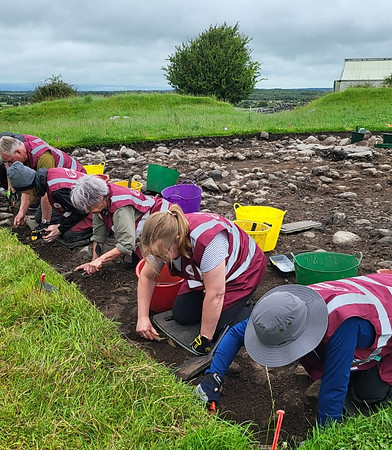
Your work at Prospecthill takes place over the course of five days, where you will immerse yourself in the excavation, collection and study of artefacts, and recording of features at a site with a 5,000-year history! The huge upright stones were removed in the 1960s but what lies underneath—nobody really knows.
You will be among the first modern people to aid in the potential discovery of artifacts dating from Early Neolithic Ireland. This year, your work will entail excavation in search of this 'lost' tomb, and excavation of its internal area. You will be hands-on for the entire five days of this excavation, learning the methods of archaeological excavation and archaeological recording. This will allow you to immerse yourself in the excavation, collection and study of everything from artefacts to large features dating from the Irish Neolithic, the era of the first farmers.
Together with the site archaeologists, you will assist in unearthing the court tomb layout. Most of these courts were semi-circular with their open side facing outwards. Some were fully enclosed courts entered by a narrow passage, while others were open but have straight sides.
During your 5-day excavation, your days will consist of:
-
Working with site directors, Dr. Noel McCarthy and Dr. Michelle Comber and other professional archaeologists. You'll also be working alongside Irish and international university students and local community participants.
-
Archaeological fieldwork begins at 9am and ends at 5pm each day.
-
You’ll break for mid-morning and lunch (It’s time to find your hearty packed lunch and enjoy a well-deserved break to your day.)
-
At about 5pm each day, your driver will be waiting for you to escort you back to the hotel.
-
Evenings are free to relax and enjoy on your own
Accommodation: Imperial Hotel, Double Occupancy
Meals: Breakfast and a packed lunch each day
Monday through Thursday evenings, dinner is on your own
Friday we'll meet for a Farewell Dinner and head out for some lively Irish Trad music
July 4 | Galway City Museum Tour + Departure

This morning, after breakfast at the hotel, we’ll set out to join a 10:30am guided tour of the Galway City Museum—an experience that brings the city’s rich past vividly to life. As we explore the museum’s fascinating archaeological collections, we’ll uncover the story of Galway’s evolution—from its origins to the vibrant city we see today. Along the way, we’ll learn about the Claddagh, delve into the revolutionary spirit of the early 20th century, and trace the threads of history that have shaped this remarkable corner of Ireland.
From there, you’ll make your own way to Dublin or Shannon airport or any other additional travels. If you are boarding a flight, be sure to arrive at the airport at least three and a half hours before your flight. Transportation to and from the airport can be arranged for an additional fee.
Meals: Breakfast
What to Bring for the Prospecthill Archaeology Dig

You will be working under the supervision of the archaeologists for the duration of the excavation. Note that the tasks associated with working on an excavation can involve certain risks. Excavation work may involve difficult conditions, uneven terrain, unanticipated natural hazards, use of digging equipment, and/or strenuous manual labor. A general level of fitness is necessary for excavations, such as walking over uneven ground every day, kneeling, filling and carrying buckets of soil and stones. All activities will occur outdoors and are subject to the weather.
This is a rural area, so expect to encounter pollen, wild vegetation, (like nettles) and insects - none of these are poisonous or very harmful in Ireland.
The Irish weather is notoriously changeable - rain, wind, sun all in one day; and sometimes even all at once! Generally, though, none of these are too extreme in summer and are easily managed with appropriate clothing.
On-site facilities are rustic. There are no bathrooms, but portable toilets will be available. There will also be a few on-site tents for daytime shelter.
Click here for more details on what to expect on an archaeology dig.
Please pack:
-
Waterproof boots
-
Waterproof coat
-
Waterproof over-trousers
-
Clothes layers that can be removed
-
A hat for both rain and sun
-
Gardening gloves
-
Sunscreen
-
Allergy and other medications if needed
-
Water bottle
-
Backpack
Inclusions and Exclusions

Includes:
-
Pricing is based on per person, double-occupancy.
-
Single occupancy starts at €5,565.
-
A €500 deposit is due upon booking. Final payment due on May 1, 2026
-
Cancellations: Once a booking is confirmed and final payment is made, a 15% cancellation fee will be charged 43-56 days prior, a 25% cancellation fee will be charged 30-42 days prior, a 50% cancellation fee will be charged 30-42 days prior and cancellations under 7 days before the trip are 100% non-refundable.
-
All tools for archaeological excavation are provided, along with dedicated on-site training, instruction, and supervision.
-
The cost of the dig includes funds to support the archaeological fieldwork and research at Prospecthill, including a contribution to artifact conservation and radiocarbon dating.
-
6 nights accommodations in Galway with breakfast included each morning
-
All transportation to and from the site for 5 days
-
Packed lunch, snacks and water each day for the dig site
-
Welcome and farewell meals
Excludes:
-
International airfare
-
Arrival and departure transportation to Galway accommodations. Airport transfers can be arranged for an additional cost.
-
Any evening activities
-
Lunch on your arrival and departure days
-
Travel Insurance is mandatory
-
All other travel necessities /valid passports and visas, for travel from point of original departure through to the final destination are strictly the responsibility of the traveller.
An interview with Noel McCarthy, Archaeology, University of Galway

-
What makes the Prospecthill significant?
TThe site lies at a notable juncture in the Irish landscape. It is at the western end of the Slí Mór, the ancient east-west routeway that extends across Ireland, as well as being in a coastal position offering access to routeways along the Atlantic seaboard. It is at the inner reaches of the sheltered Galway Bay within what was likely a busy Neolithic landscape. As the location was easy to access and surrounded by very fertile soils it would have been very attractive to the first farmers coming into the region in the early Neolithic. Understanding the role of the monument and precisely dating its construction will inform greatly upon this pivotal period in Ireland's past. The last upstanding remains of the monument were demolished in the 1960s after which, though the general location was known, the site was considered lost. Recent study has shown that the footprint of the site survives, indicating a c.40m long trapezoidal cairn and possible features within. The condition of the site offers the rare opportunity to investigate a Neolithic tomb without interfering with an upstanding example and thus not further diminishing a very finite resource. Few court tombs have been excavated in modern times, using modern excavation, analysis and dating techniques. Fewer still have been excavated in low-lying coastal areas, giving the opportunity to fill a void in the archaeological record and create a stronger narrative for this region of western Ireland. -
What has been most surprsing about your discoveries here?
The site has not previously been excavated, though 33 stone axes of possible Neolithic date have been found in the local area. In total 140 stone axes have been found on the Maree peninsula (c.14 sq. km) which is a very strong concentration in the west of Ireland. -
What are your current research objectives at Prospecthill?
The monument has been recorded as a court tomb but there is great variability in the actual layout of such tombs. This excavation will identify the form this tomb originally had as well as confirm its extent. The site is located quite a distance south of the main concentration of court tombs in Ireland. The excavation will investigate if the monument has the characteristics of these more northern forms, or follows that of a more southerly 'atypical court tomb'. The excavation will assess the condition of the sub-surface remains of the now demolished tomb and recover any artefacts and remains that survive within and around the tomb.
About The Prospecthill Neolithic Court Tomb Archaeology Dig in Ireland
The Great Plains Dinosaur Museum and Field Station is located in the rich land mass of Northeastern Montana, where some of the world’s best preserved dinosaur fossils have been discovered. The Museum also provides the opportunity for both youth and adults to learn, explore, dig, and excavate fossils with Museum staff and paleontologist partners at onsite dig programs and other educational programs.
Both the adult and junior field programs take place in the Judith River Formation, renowned for being the location where, in 1855, the very first dinosaur fossil in the western United States was discovered.
The early American paleontologist Edward Drinker Cope led expeditions to this area in the 19th century and since then, a dizzying array of all kinds of prehistoric life has been discovered here. Amazing and new dinosaur discoveries continue to be reported from Northeast Montana all the time, even after 160 years of exploration!
How you will make an impact on this dig
Your participation in the Maree Pxxxxx


There are two digs offered at the Great Plains Dinosaur Field Station.
1~Junior Paleontology Field Experience
-
Ages 5-11 (must be accompanied by an adult)
-
3 hours
At a special site just a short trip from Malta, this program is designed to teach children about the science and techniques of geology and paleontology in the real setting and by practicing with real dinosaur fossils! All participants must be accompanied by an adult.
*Also available is a private Junior Field Experience, for an additional $25/participant.
2~Adult Paleontology Program
-
Ages 12+ (minors must be accompanied by an adult)
-
Participants have the option of signing up for 1-5 days
This summer, fieldwork will consist of prospecting or looking for fossils and finding new places to dig. Prospecting is the important initial step to fieldwork. Participants will learn to recognize fossil bone eroding out of a hill, basic local geology, and how to collect and record scientific data. If we are lucky enough to find any substantial specimens, we’ll record locations and might even open up a quarry to start digging!
Each day starts by meeting up the Museum bright and early to begin our day of discovery! These prospecting days will consist of walking along the hills and slopes of the badlands all day in search of the elusive fossil treasures waiting to be discovered. We’ll have access to a vehicle, but be prepared to spend all day walking around and exploring what the badlands have to offer. That can mean little if any shade, and no comfort of modern indoor plumbing.
Every single fossil the Museum collects is donated and prepared at the Great Plains Dinosaur Museum for research and exhibits. That means that fossils you find could be preserved locally for everyone to enjoy!
June 28 | Arrival in Galway + Welcome Dinner
Make your way to Galway City from Dublin or Shannon Airport to your home base in Galway City for the archaeological dig at Prospecthill.
Galway, known as the City of Tribes is a city filled with energy, history and a lively nightlife. The cobbled medieval streets are home to all sorts of pubs, craft shops and cafés. Head to Kirwan's lane where you’ll find musicians playing for the crowds or daredevil street performers defying danger. Kirwan's Lane is also home to relics of 16th and 17th century architecture.
During the course of the day, you’ll make your way to the Imperial Hotel where we will be staying for the next 6 nights. Check in at 3pm (if you’re early, feel free to drop your bags) The hotel is in the heart of Galway City and only about a minute from Eyre Square. It’s close to some of Galway’s best bars and restaurants and the cobbled Shop Street, the retail hub of Galway.
You'll meet your dig companions tonight for a Welcome Dinner before heading back to the Hyde Hotel to settle in for the night. Tomorrow starts the real adventure!
Accommodation: Imperial Hotel in Galway, Double Occupancy
Meals: Welcome Dinner
June 29-July 3 | Prospecthill Archaeological Excavation
Your work at Prospecthill takes place over the course of five days, where you will immerse yourself in the excavation, collection and study of artefacts, and recording of features at a site with a 5,000-year history! The huge upright stones were removed in the 1960s but what lies underneath—nobody really knows.
You will be among the first modern people to aid in the potential discovery of artifacts dating from Early Neolithic Ireland. This year, your work will entail excavation in search of this 'lost' tomb, and excavation of its internal area. You will be hands-on for the entire five days of this excavation, learning the methods of archaeological excavation and archaeological recording. This will allow you to immerse yourself in the excavation, collection and study of everything from artefacts to large features dating from the Irish Neolithic, the era of the first farmers.
Together with the site archaeologists, you will assist in unearthing the court tomb layout. Most of these courts were semi-circular with their open side facing outwards. Some were fully enclosed courts entered by a narrow passage, while others were open but have straight sides.
During your 5-day excavation, your days will consist of:
-
Working with site directors, Dr. Noel McCarthy and Dr. Michelle Comber and other professional archaeologists. You'll also be working alongside Irish and international university students and local community participants.
-
Archaeological fieldwork begins at 9am and ends at 5pm each day.
-
You’ll break for mid-morning and lunch (It’s time to find your hearty packed lunch and enjoy a well-deserved break to your day.)
-
At about 5pm each day, your driver will be waiting for you to escort you back to the hotel.
-
Evenings are free to relax and enjoy on your own
Accommodation: Imperial Hotel, Double Occupancy
Meals: Breakfast and a packed lunch each day
Monday through Thursday evenings, dinner is on your own
Friday we'll meet for a Farewell Dinner and head out for some lively Irish Trad music
July 4 | Galway City Museum Tour + Departure
This morning, after breakfast at the hotel, we’ll set out to join a 10:30am guided tour of the Galway City Museum—an experience that brings the city’s rich past vividly to life. As we explore the museum’s fascinating archaeological collections, we’ll uncover the story of Galway’s evolution—from its origins to the vibrant city we see today. Along the way, we’ll learn about the Claddagh, delve into the revolutionary spirit of the early 20th century, and trace the threads of history that have shaped this remarkable corner of Ireland.
From there, you’ll make your own way to Dublin or Shannon airport or any other additional travels. If you are boarding a flight, be sure to arrive at the airport at least three and a half hours before your flight. Transportation to and from the airport can be arranged for an additional fee.
Meals: Breakfast
What to Bring for the Prospecthill Archaeology Dig
The Great Plains Museum provides all tools and necessary equipment for the digs, but each participant should come prepared for spending a day out in the field. You’re welcome to take pictures of your adventure as well.
The Great Plains Dinosaur Museum will provide training in proper paleontology techniques and all the tools for digging and collecting, jacketing, and transporting fossils. A sack lunch and water is included for each participant as well.
Click here for more details on what to expect on a paleontology dig.
Please pack:
-
Close-toed shoes (NO flip-flops, sandals or crocs-NO exceptions)
-
Small backpack or tote
-
Light weight clothing
-
Neck Scarf
-
Sun hat
-
Sunglasses
-
Sunscreen
-
Bug spray
-
Water bottle
-
camera
Inclusions and Exclusions
Includes:
-
Pricing is based on per person, double-occupancy.
-
Single occupancy starts at €5,565.
-
A €500 deposit is due upon booking. Final payment due on May 1, 2026
-
The Great Plains Dinosaur Museum will provide training in proper paleontology techniques and all the tools for digging and collecting, jacketing, and transporting fossils. A sack lunch and water is included for each participant as well.
-
-
For the Adult program, lunch, snacks, and water, as well as transportation to and from the dig location is provided.
-
-
For the Junior Program, all participants must be accompanied by an adult and have their own transportation to and from the site.
-
Excludes:
-
Accommodations
-
Arrival and departure transportation to Galway accommodations. Airport transfers can be arranged for an additional cost.
-
Any evening activities
-
Lunch on your arrival and departure days
-
If traveling internationally, travel Insurance is mandatory
-
An interview with xxxxx, Archaeology, University of Galway
-
What makes the Prospecthill significant?
TThe site lies at a notable juncture in the Irish landscape. It is at the western end of the Slí Mór, the ancient east-west routeway that extends across Ireland, as well as being in a coastal position offering access to routeways along the Atlantic seaboard. It is at the inner reaches of the sheltered Galway Bay within what was likely a busy Neolithic landscape. As the location was easy to access and surrounded by very fertile soils it would have been very attractive to the first farmers coming into the region in the early Neolithic. Understanding the role of the monument and precisely dating its construction will inform greatly upon this pivotal period in Ireland's past. The last upstanding remains of the monument were demolished in the 1960s after which, though the general location was known, the site was considered lost. Recent study has shown that the footprint of the site survives, indicating a c.40m long trapezoidal cairn and possible features within. The condition of the site offers the rare opportunity to investigate a Neolithic tomb without interfering with an upstanding example and thus not further diminishing a very finite resource. Few court tombs have been excavated in modern times, using modern excavation, analysis and dating techniques. Fewer still have been excavated in low-lying coastal areas, giving the opportunity to fill a void in the archaeological record and create a stronger narrative for this region of western Ireland. -
What has been most surprsing about your discoveries here?
The site has not previously been excavated, though 33 stone axes of possible Neolithic date have been found in the local area. In total 140 stone axes have been found on the Maree peninsula (c.14 sq. km) which is a very strong concentration in the west of Ireland. -
What are your current research objectives at Prospecthill?
The monument has been recorded as a court tomb but there is great variability in the actual layout of such tombs. This excavation will identify the form this tomb originally had as well as confirm its extent. The site is located quite a distance south of the main concentration of court tombs in Ireland. The excavation will investigate if the monument has the characteristics of these more northern forms, or follows that of a more southerly 'atypical court tomb'. The excavation will assess the condition of the sub-surface remains of the now demolished tomb and recover any artefacts and remains that survive within and around the tomb.